
Bagpiper in Fort Augustus

Caledonian Canal.

Fort Augustus is halfway between Inverness and Fort William, on the Scottish Highlands's southwest end of Loch Ness. The impressive 60-mile-long Caledonian Canal offers spectacular views down Loch Ness River.
Fort Augustus is a paradise for hikers and cyclists, with many beautiful walks around the area, the most popular being the Great Glen Way.

The Commando Memorial, unveiled by Her Majesty Queen Elizabeth the Queen Mother on September 27, 1952, is dedicated to all the
Commandos who died during the 1939-1945 War.

In the 1300s, Urquhart featured prominently in the Scots' struggle for independence. Once one of Scotland’s largest castles, Urquhart saw great conflict during its 500 years as a medieval fortress.
Control of the castle passed back and forth between the Scots and English during the Wars of Independence. The castle came under the control of Robert the Bruce after he became King of Scots in 1306. In 1332, the dark days following Robert I's death, Urquhart was the only Highland castle to hold out against the English.
The power struggles continued, as the Lords of the Isles regularly raided the castle and glen until the 1500s. The last government troops garrisoned here during the Jacobite Risings blew up the court when they left. Urquhart’s iconic ruins remain, offering glimpses into medieval times and the lives of its noble residents.


Duart Castle, on the Isle of Mull, is located beside the Sound of Mull off the west coast of Scotland. The castle dates back to the 13th century and is the seat of Clan MacLean. Sir Fitzroy Maclean, the 26th Chief, purchased the ruined Castle in 1910. He then began the enormous task of repairing the building. Unfortunately, scaffolding and repairs impacted its beauty and prevented us from entering.

The Duart Castle
INVERNESS REVEALED
Inverness, the largest city and the cultural capital of the Scottish Highlands is on Scotland’s northeast coast, where the River Ness meets the Moray Firth. It is the hub of the Highlands and the closest town to Loch Ness, home to the Loch Ness monster legend. Its Old Town features the 19th-century Inverness Cathedral, the mostly 18th-century Old High Church, and an indoor Victorian Market selling food, clothing, and crafts.
There is one architectural Kodak moment after another in this easily walkable town.


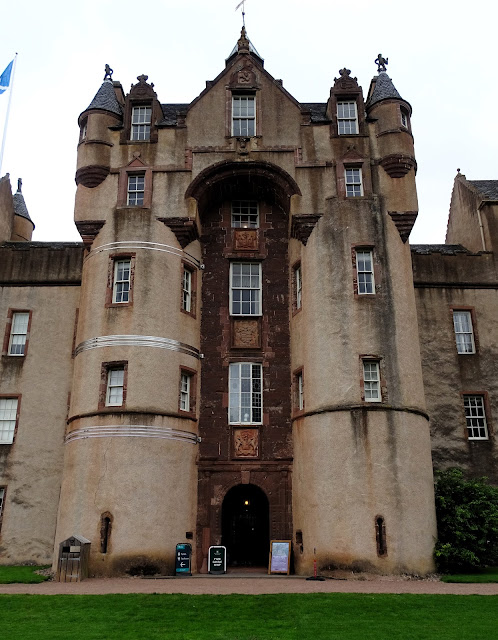
(front entrance above, side gardens below).

We visited the Culloden Battlefield, the last major battle fought on mainland British soil on April 16, 1746. More than 1,500 soldiers died within one hour on this site of the final Jacobite uprising, which ended when Government forces led by the Duke of Cumberland crushed the army of Prince Charles Edward Stuart.


Once again, our hotel, the Best Western Palace, occupied a prime location on the bank of River Ness, an easy walk across the bridge from Old Town.
Life in Old Town was exhausting. First, I grabbed a large carton of delicious Thai peanut noodle salad at the Good Girl Greengrocer in the Victorian Market to go along with the red wine in my room from another affordable Tesco store near our hotel.
Then, there was whisky tasting at the Malt Room (I gave all 3 of my samples to Lowell), followed by dinner at the Whitehouse. My main course featured battered fish and chips, lemon, mushy peas, and tartar sauce, and for dessert, I chose the Highland Cranachan - oats, whipped cream, raspberries, and toasted oats.
We were fixated by the live entertainment outside the restaurant windows facing the River Ness. Two or three inebriated adults apparently declared their grievances in the canal. Police, ambulances, and first responders who arrived on the scene had their hands full but eventually locked the guilty parties in the back of a truck and took off.

The night was young, but a few us were getting older. (Not me. The highland's bagpipe music demanded dancing, and I accommodated with some guy dancing solo.)

Hootananny live music.
(Rated #1 on Yelp for top 10 Best Music Venues Near Inverness)

Comments
Post a Comment